

Pierre Marchant (also Marchand; active in Paris in the early seventeenth century).
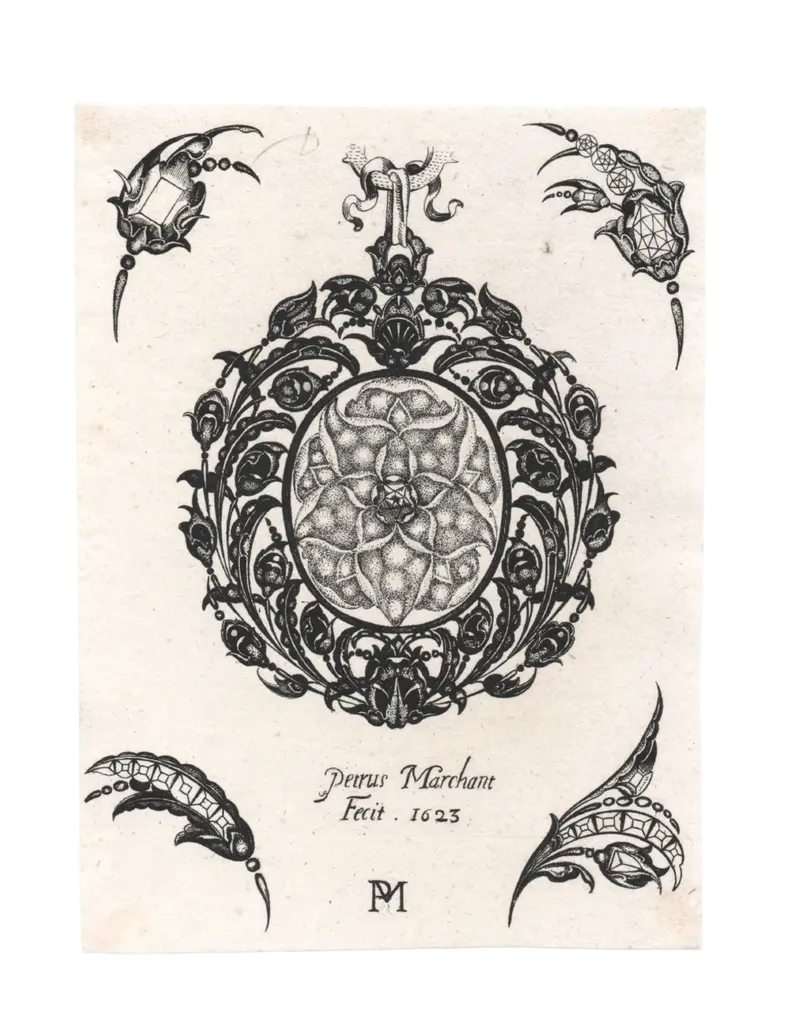
Bouquets de joaillerie, feuilles stylisées et cosses de pois. Three ornament prints from the suite, including the signed and dated title plate.
[Paris], 1623 (date on title plate).
Three loose copperplate prints, engraving and blackwork on laid paper. Sheets approximately 11.8 × 8.5 to 13 × 9.8 cm. Title plate inscribed Petrus Marchant / Fecit. 1623, with the interlaced PM monogram below.
Strong, dark impressions with fine detail. Sheets trimmed, sometimes close to the compositions; no platemarks visible. Light overall toning, scattered small spots and minor surface soiling, with faint pencil annotations. No significant tears or losses visible.
Rare examples of the cosse de pois, or peapod style, a short-lived fashion in French ornament that flourished around 1615–1635. Marchant transforms pea flowers, pods and curling tendrils into elaborate jewellery: peas become pearls or faceted diamonds, while open pods provide settings for gemstones. The designs combine fine engraved lines with blackwork, a technique producing dense black areas articulated by fine white reserves, recalling contemporary enamelled jewellery. As Marika Takanishi Knowles explains in Ornament in the Kitchen Garden (2017), these suites were more than practical models: they allowed goldsmiths to demonstrate their inventiveness and promote their individual styles. Marchant, a Protestant goldsmith working on the Île de la Cité, published his suite two years before his admission to the Parisian goldsmiths’ guild in 1625.
We have traced only two institutional holdings of original impressions from the suite: one at The Metropolitan Museum of Art in New York, not illustrated in its online catalogue, and another mounted in an album in the Bibliothèque de l’Institut national d’histoire de l’art (INHA) in Paris. Curiously, comparison of the present three sheets with the corresponding INHA impressions reveals differences that are not uniform across the suite. The monogrammed floral design coincides closely in its linework and appears to have been printed from the same copperplate. The title plate and the large jewelled spray, however, differ in the positioning of subsidiary motifs relative to the principal designs. The present title plate also bears a large PM monogram absent from the INHA impression. These discrepancies suggest a separately configured or re-engraved version of at least part of the suite, although the precise relationship between the versions remains unresolved.
The Metropolitan Museum also holds a title plate acquired in 1919 and catalogued as a ‘facsimile’. Its record describes both Marchant’s full inscription and his monogram, providing a further reference for the monogrammed version. Without a reproduction or physical examination, however, its classification as a ‘facsimile’ cannot be independently assessed. The original extent of the suite also merits clarification: Guilmard described seven plates, whereas the groups traced at the Metropolitan Museum and INHA each comprise six—a title plate and five designs. The present group is therefore described simply as three sheets from the suite.
References:
Guilmard, Désiré. Les maîtres ornemanistes. Paris, 1880, p. 40, no. 16.
Staatliche Museen zu Berlin. Katalog der Ornamentstich-Sammlung der Staatlichen Kunstbibliothek Berlin. Berlin and Leipzig, 1939, p. 118, no. 795.
Fuhring, Peter, and Michèle Bimbenet-Privat. “Le style ‘cosse de pois’: l’orfèvrerie et la gravure à Paris sous Louis XIII.” Gazette des Beaux-Arts, vol. 139, no. 1595, January 2002, pp. 1–224.
Knowles, Marika Takanishi. “Ornament in the Kitchen Garden: The Pea as Motif for Goldsmithing in the France of Louis XIII.” Art History, vol. 40, no. 5, 2017, pp. 964–993.
The Metropolitan Museum of Art, New York, Department of Drawings and Prints. Pierre Marchant, Title Page: Design for Jewelry and five accompanying jewellery designs, 1623. Engraving and blackwork. Harris Brisbane Dick Fund, 1924, accession nos. 24.100.9–24.100.14. See also Title Page to a Set of Seven Designs for Jewelry, catalogued as a ‘facsimile’, Rogers Fund, 1919, accession no. 19.66.
Bibliothèque de l’Institut national d’histoire de l’art, Collections Jacques Doucet, Paris. Pierre Marchand, six plates from Bouquets de joaillerie, feuilles stylisées et cosses de pois, 1623, mounted in Petits maîtres I. École française: Carteron, Christollien, Firens, Gandin, Hurtu, Hedouyns, Marchant, Millot, Nolin. Shelfmark FOL RES 120 (1–12), fols. 58–63; digital identifier NUM FOL RES 120 (1–12).


Beoordelingen
Er zijn nog geen beoordelingen.